Blog
AI Supply Chain Attacks
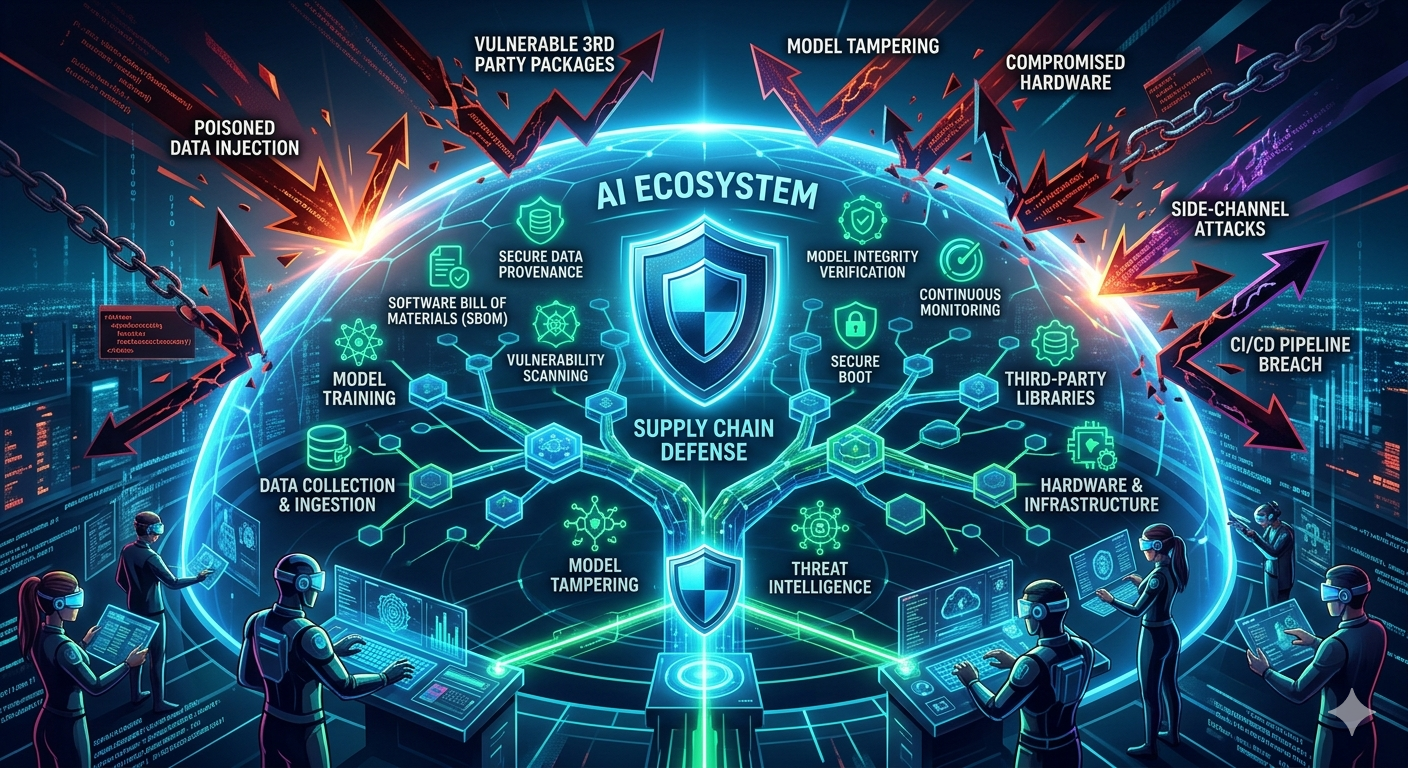
Package ecosystems like CPAN and PyPI function as environments where trust is continuously produced through visible practice rather than static verification. This analysis examines how agentic systems disrupt this legibility by optimizing for task completion over context, eroding the reputational signals that stabilize software supply chains. It proposes design shifts for agent infrastructure to restore context-aware dependency selection.
Reputation as Infrastructure: CPAN, PyPI, and Supply Chain Defense
Published Apr 21, 2026 Topics supply-chain-security package-ecosystems reputational-accountability agentic-infrastructure open-source-culture
There is a tendency to treat software supply chains as technical systems that occasionally fail. A compromised package appears, a dependency is poisoned, a patch is issued. The frame remains intact: the problem is verification, and the solution is better verification.
But this framing is incomplete.
Package ecosystems like CPAN and PyPI suggest a different interpretation. They operate less as distribution systems and more as environments where trust is continuously produced, observed, and contested. The code moves, but what stabilizes the system is not the code itself. It is the accumulation of visible practice around it.
The Social Layer of the Supply Chain
Both CPAN and PyPI expose more than artifacts. They expose authorship.
Every package carries with it a trace: who published it, how often it is updated, how it relates to other packages, whether others depend on it, how long it has persisted. These signals are not formal guarantees. They are contextual indicators.
This produces a distinct mode of evaluation. A package is rarely assessed in isolation. It is interpreted through its position in a network of maintainers, dependencies, and usage.
The result is not security in the strict sense. It is legibility.
And legibility changes behavior. It enables users to notice anomalies, to hesitate, to compare, to defer. It distributes the work of judgment across the ecosystem rather than concentrating it in a single control point.
Failure as a Property of Attention
Supply chain attacks exploit moments where this legibility collapses.
Typosquatting succeeds when naming conventions outpace scrutiny. Dependency confusion succeeds when implicit trust in internal naming leaks into public resolution. Malicious updates succeed when maintainers lose control or when downstream users stop paying attention.
These are not purely technical failures. They are failures of attention within a system that depends on continuous interpretation.
The response from these ecosystems has followed the same logic. Security improvements—two-factor authentication, namespace controls, moderation—have been introduced. But they operate alongside, not instead of, the underlying culture of visibility and participation.
The system does not eliminate risk. It maintains the conditions under which risk can be detected and absorbed.
Reputation as a Process, Not a Credential
What emerges from these environments is a specific form of reputational accountability.
Not a score, not a badge, but a trajectory.
Maintainers accumulate trust through continuity. Packages gain stability through adoption. Dependencies attract scrutiny in proportion to their centrality. Anomalies surface through deviation from expected patterns.
This form of reputation is slow. It resists abstraction. It requires interpretation.
But it scales in a way that static guarantees do not. It adapts to new threats because it is not fixed in advance. It is continuously recomputed through use.
The Agentic Pressure
The introduction of agentic systems places new pressure on this model.
Agents do not inherit the interpretive habits of human developers. They resolve dependencies programmatically. They optimize for task completion. They treat package ecosystems as inventories rather than environments.
This creates a structural asymmetry. The system assumes a user capable of interpreting reputation, while the agent operates without that context.
The risk is not only increased exposure to malicious packages. It is the erosion of the very signals that made the system navigable. If selection becomes automated without regard for context, the feedback loops that sustain reputational accountability weaken.
Toward Reputational Awareness in Agents
If agents are to operate safely within these ecosystems, they will need to engage with the same signals that humans use, but in a form that can be operationalized.
This suggests a shift in how agentic systems are designed:
- Package selection informed by maintainer continuity and activity patterns
- Dependency evaluation weighted by ecosystem centrality and adoption
- Detection of anomalous publication behavior or naming collisions
- Integration of community signals, advisories, and historical context
These are not replacements for cryptographic verification or policy controls. They are complementary layers that restore context to automated decision-making.
Package Ecosystems as Precedent
CPAN and PyPI can be understood as early instances of a broader pattern: infrastructure that embeds social signals directly into technical systems.
They demonstrate that supply chain defense is not achieved by removing the human element, but by structuring it.
In this sense, they function as epistemic infrastructure. They do not decide what is trustworthy. They make trust decisions possible under conditions of uncertainty.
What Stabilizes
Openflows tracks systems in motion—what is emerging, what is consolidating, what is quietly persisting.
CPAN and PyPI fall into the latter category. They are not new. They are not optimized for current narratives about AI or security. But they have sustained a form of distributed accountability that remains underexamined.
As agentic systems begin to participate directly in software supply chains, this older pattern becomes newly relevant.
Not as nostalgia, but as precedent.
Referenced Entries
- Inspectable Agent Operations Circuit (inspectable-agent-operations)
- Agent Execution Sandboxing Infrastructure (agent-execution-sandboxing-infrastructure)
- Autonomous Security Ops Governance Circuit (autonomous-security-ops-governance)
- Operational Literacy Interface Circuit (operational-literacy-interface)
- Open Weights Commons Circuit (open-weights-commons)
- Terminal-Native Agentic Workflows (terminal-native-agentic-workflows)
- Signal Drift (signal-drift)
- Feedback Circuit (feedback-circuit)