Blog
Entre Nous
An analysis of the Nous Research Discord as an epistemic culture around agentic systems. Examining how Hermes functions as a shared object of inquiry rather than a product, and how intellectual permeability fosters collective literacy without the urgency of typical technical communities.
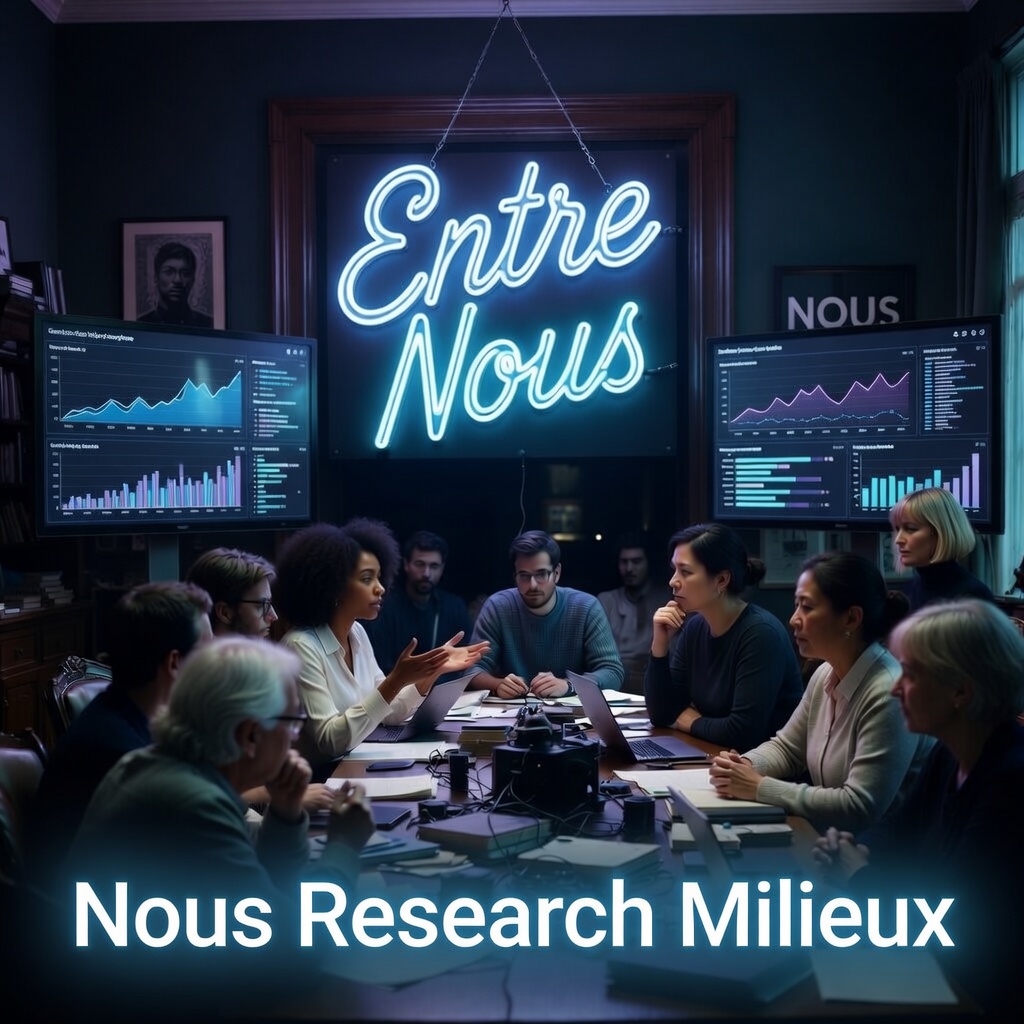
There are online spaces that feel like markets—loud, transactional, optimized for attention. And then there are spaces that feel like workshops, or even salons, where something slower and more deliberate is taking shape. The Nous Research Discord sits firmly in the latter category. It has the texture of a place where people are thinking in public, but not performing; where the goal is not to win an argument, but to refine one.
“Entre Nous” feels like the right frame for it. Not as a gesture of exclusion, but as a description of tone. The conversations unfold as if among peers who assume one another’s capacity, who grant seriousness as a default. There is a kind of quiet trust embedded in that assumption, and it changes the entire atmosphere. You don’t need to posture when the room is already listening.
What’s striking is how this culture has cohered around Hermes—not simply as a model or an agent, but as a shared object of inquiry. Hermes is treated less like a product and more like a site of ongoing interpretation. People probe its behavior, test its limits, compare notes, and gradually assemble a kind of collective literacy around it. The agent becomes a medium through which thinking itself is examined.
That collective literacy is what distinguishes the space. In most technical communities, knowledge fragments quickly—into hacks, tricks, competitive advantage. Here, the instinct runs in the opposite direction. Insights are articulated, contextualized, and offered back to the group. There is a sense that understanding deepens when it circulates, when it is exposed to others who are equally capable of extending or challenging it.
The result is a rare combination: high intelligence without arrogance, and high standards without hostility. Disagreement is present, but it tends to sharpen rather than fracture. When someone pushes back, it is usually with care—an effort to improve the line of thought rather than to dismiss it. The culture enforces itself not through moderation, but through expectation.
Part of what makes this possible is the shared orientation toward the work itself. Hermes, and more broadly the development of agentic systems, demands a kind of hybrid literacy—technical, philosophical, and practical all at once. The people drawn into this space seem to recognize that no single perspective is sufficient. That recognition produces a kind of intellectual humility, even among those who are clearly operating at a high level.
There is also a noticeable absence of urgency. Not in the sense of complacency, but in the refusal to rush conclusions. Threads evolve over hours or days. Ideas are revisited, reframed, sometimes abandoned. In a digital environment that rewards immediacy, this slower tempo feels almost countercultural. It allows for a different kind of thinking—less reactive, more compositional.
If there is a politics to this space, it is subtle but real. It suggests that the future of AI development may depend less on scale or capital, and more on the cultivation of environments where rigorous, shared inquiry can take place. Not open in the sense of indiscriminate access, but open in the sense of intellectual permeability—where good ideas can move, be tested, and take root.
“Entre Nous” names that condition. A space where the boundary is not enforced by gatekeeping, but by practice. Where participation implies a certain level of care—care in how one reads, how one responds, how one builds on what others have said.
In that sense, the Nous Research Discord is not just a community around Hermes. It is an early example of what an epistemic culture around agentic systems might look like when it is allowed to mature on its own terms.
Referenced Entries
- Hermes Agent (hermes-agent)
- Nous Research (nous-research)
- Operational Literacy Interface Circuit (operational-literacy-interface)